Lighting That Feels Right—Not Just Looks Right
A space can look perfect on day one—and still fail in daily use.
You walk into a premium office, a luxury retail store, or a beautifully designed home. Everything appears sharp, minimal, and well thought out. But within minutes, your eyes feel strained. The brightness feels harsh. You begin to feel discomfort without knowing why.
That silent failure is
glare.
In today’s architectural lighting design, lighting is no longer just about visibility—it is about visual comfort, human-centric performance, and long-term usability. This is where glare-free lighting and low UGR lighting become essential across commercial lighting solutions, office lighting systems, luxury residential lighting, and high-end architectural projects.
Because truly great lighting doesn’t just illuminate—
it feels effortless.

What is Glare in Lighting (And Why It’s a Bigger Problem Than You Think)
Glare is not simply brightness—it is uncontrolled luminance that disrupts the human visual system. It is one of the most underestimated issues in modern lighting design standards, professional lighting design, and specification-grade lighting systems.
When glare is not managed, it leads to:
- Eye strain and fatigue
- Reduced productivity in work environments
- Visual discomfort in premium interiors
- Poor lighting perception despite high lumen output
This is especially critical in commercial lighting, office lighting design, and lighting for architects and designers, where performance and comfort must coexist.Two primary types:
- Direct glare → caused by exposed or poorly shielded light sources
- Reflected glare → caused by light bouncing off polished surfaces, glass, or screens
Even the most expensive design loses its impact without proper visual comfort lighting.
Understanding UGR: The Real Metric Behind Visual Comfort
To measure and control glare, lighting professionals rely on UGR (Unified Glare Rating)—a key parameter in architectural lighting specifications and professional lighting design guidelines.
This is why low UGR lighting is now a baseline requirement in:
- Modern architectural lighting systems
- Corporate office lighting solutions
- Retail lighting design
- Healthcare lighting environments
As design standards evolve, specifically the open-plan layouts common in Gurgaon, Mumbai, and Bengaluru, low glare lighting solutions are becoming central to premium lighting design, LED architectural lighting, and energy-efficient lighting systems.
Why Glare-Free Lighting Defines Modern Architecture
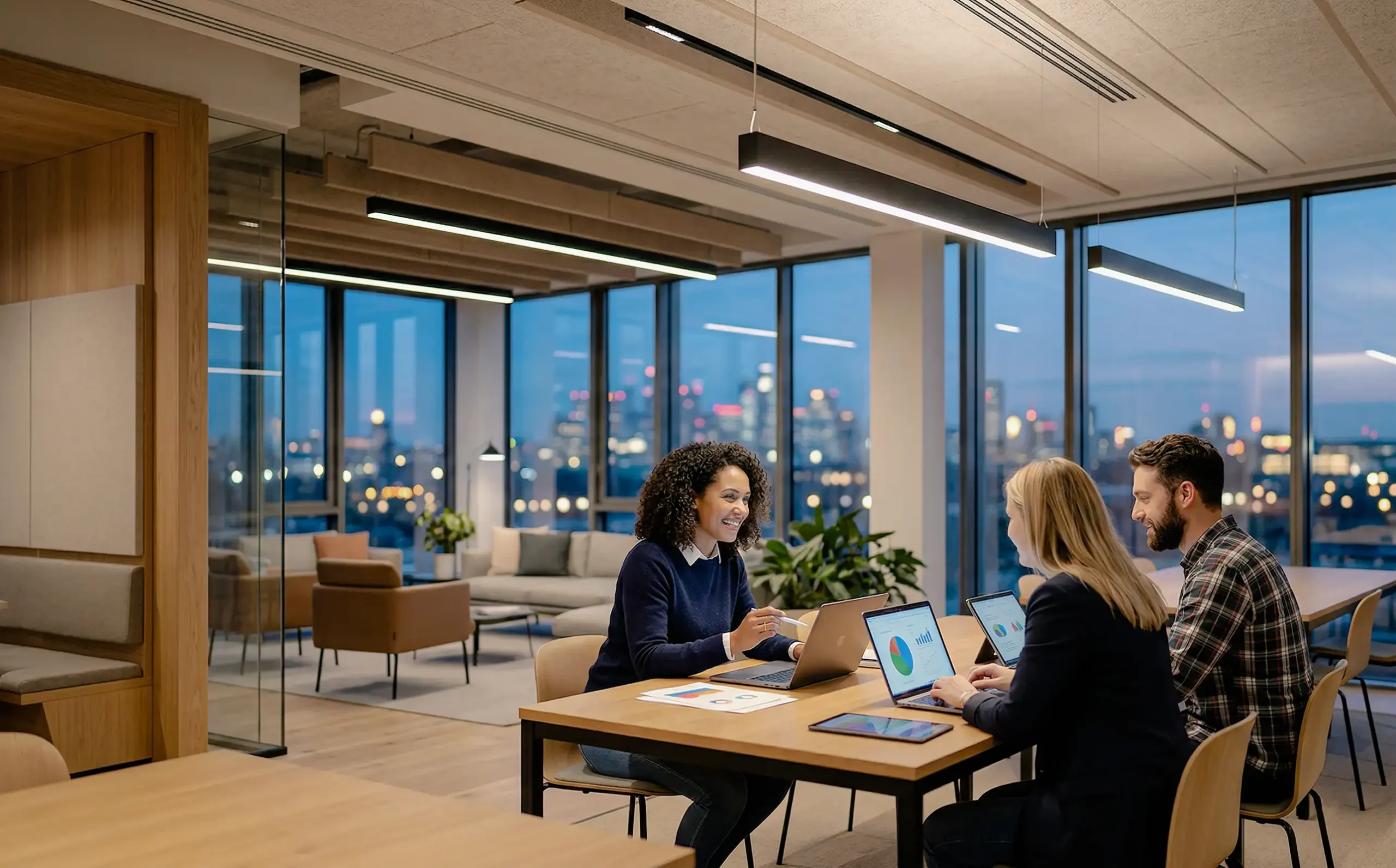
Modern architecture is defined by clean geometry, reflective materials, minimal surfaces, and open spatial planning. In such environments, lighting is not hidden—it is exposed and experienced.
This makes glare-free architectural lighting critical.
1. Visual Comfort & Human-Centric Design
Spaces feel calm, usable, and comfortable over long durations.
2. Design Integrity
Lighting enhances form, texture, and materials instead of overpowering them.
3. Productivity & Performance
In commercial office lighting and workspace lighting, low glare lighting directly improves focus and efficiency.
4. Premium Experience
True luxury lies in comfort—high-end lighting solutions must feel as refined as they look.
How Low UGR Lighting is Achieved (The Technical Side, Simplified)
Achieving glare-free lighting is not about reducing brightness—it is about engineering control into light distribution.Key techniques include:
- Advanced optical lens systems → precise light direction
- Anti-glare diffusers & micro-prismatic technology → soften luminance
- Deep recessed architectural lighting fixtures → reduce direct exposure
- Micro-reflector technology → optimize beam control
- Strategic lighting layout planning → eliminate hotspots and imbalance
These systems work together to deliver uniform illumination, high-performance LED lighting, and visually comfortable environments.
Where Low UGR Lighting Makes the Biggest Impact
The importance of low UGR lighting solutions becomes critical in:
- Corporate offices & workspace lighting systems
- Retail and showroom lighting design
- Healthcare and hospital lighting solutions
- Hospitality lighting environments
- Luxury residential architectural lighting
In these environments, glare-free lighting is not a luxury—it is a functional necessity.
The Shift Towards Human-Centric Lighting
Lighting design is evolving toward human-centric lighting systems, where comfort, well-being, and usability define performance.Low UGR lighting plays a foundational role by:
- Reducing visual fatigue
- Supporting long working hours
- Enhancing spatial clarity
- Creating balanced, adaptive environments
The future of lighting is not brighter—it is smarter, softer, and more responsive to human needs.
Final Thought: The Detail That Separates Good from Exceptional
Anyone can light a space.
But only a few understand how to make it
feel right.
The difference lies in details like UGR ratings, glare control technology, optical precision, and lighting design expertise—elements that are often invisible, yet deeply experienced.
That is what defines specification-grade architectural lighting, premium LED lighting systems, and high-performance lighting solutions.
And as expectations from modern spaces continue to rise, glare-free lighting and low UGR lighting are no longer optional—they are the new standard of excellence.